Earlier this month, I was assigned to participate in a group project for a class I’m taking called “Evolution of Warfare”. It’s taught by a Captain in the marine corps. The goal of the project: to develop a plan to deploy marines in littoral waters in order to counter aggression from the fictional “People’s Republic of Azuria”. The goal of our incursion was to deny operational freedom to Azurian forces while asserting freedom of navigation for civilian vessels in surrounding waters. We chose Scylla and Charybdis as the operation’s designation, a homage to the great leviathans blocking Odysseus’ path in the Odyssey.
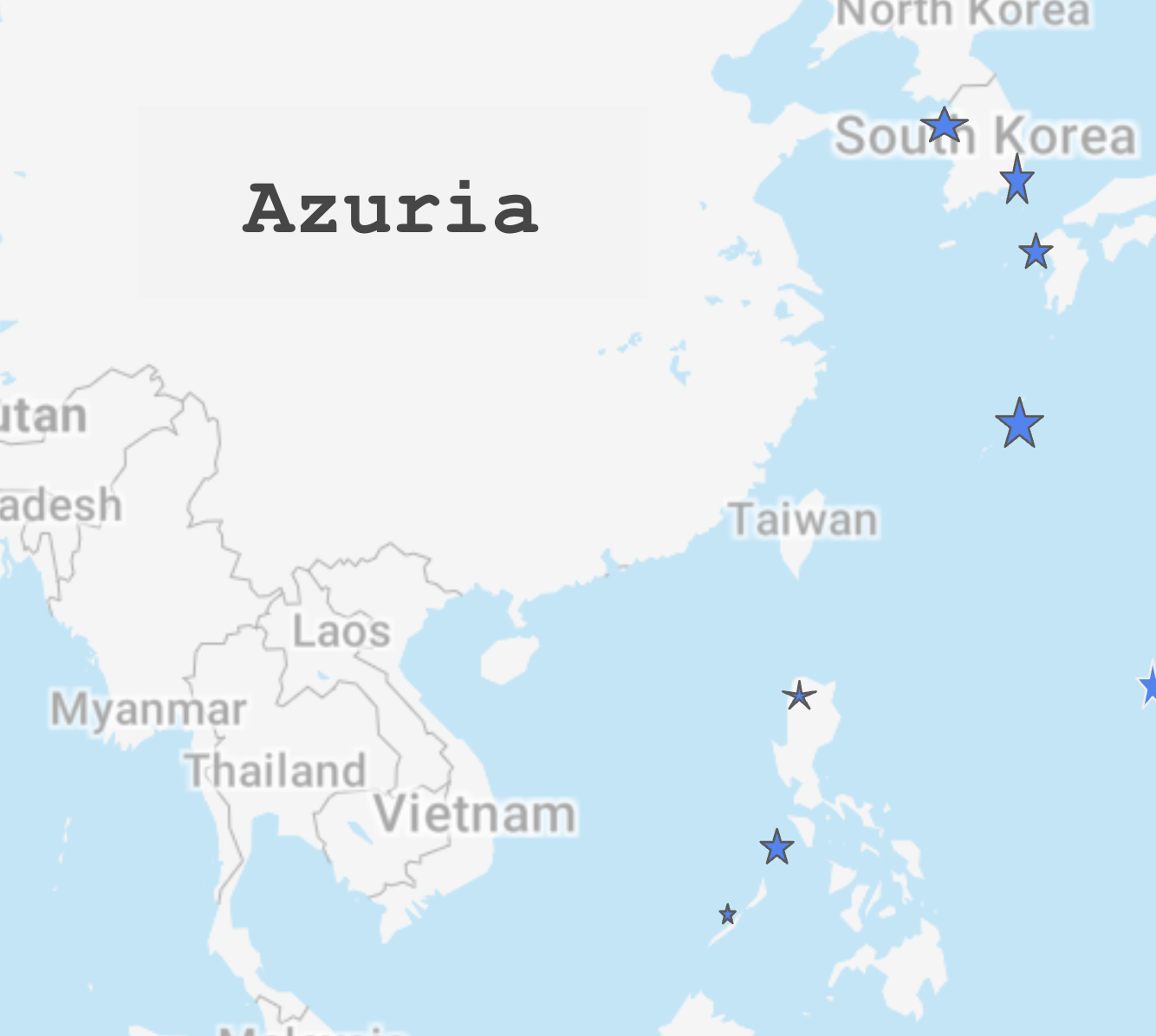
Something looks awfully familiar about this fictional country…
Azuria was, if it isn’t already clear at this point, an analogue for the People’s Republic of China. China has built artifical islands throughout surrounding waters, using them as bases from which to harrass fishing and trading vessels in the South China Sea. Azuria, within the context of the fictional scenario, was up to something similar. Our plan: to put an end to this tomfoolery with the help of our boys in the 3rd Marine Division.
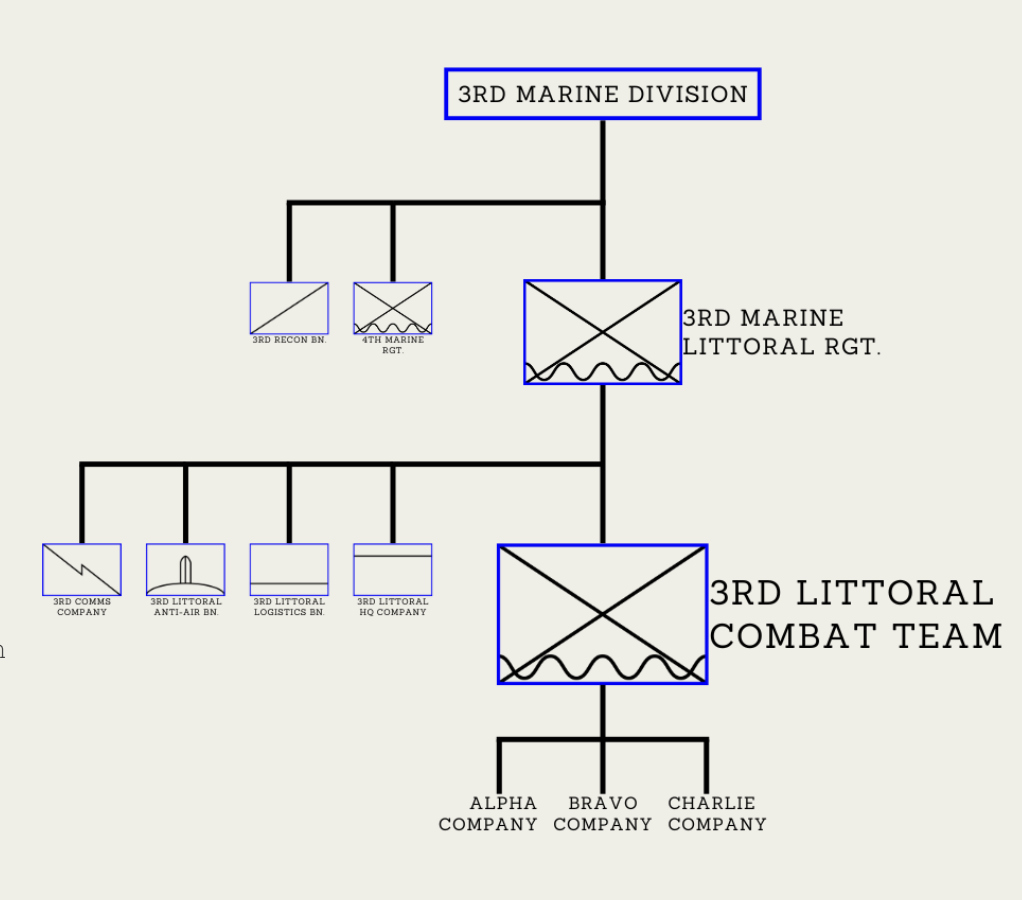
Force organization chart for the 3rd Marine Division.
Towards this end, we plotted out that we would deploy to the island of Palawan, performing recon beforehand with the help of an MQ-9 Reaper flyover. The 3rd Littoral Combat Team (LCT) would conduct initial landing operations, with F-35B air cover from VMFA-242 and VMFA-121 out of the Marine Corps air station at Iwakuni, Japan. Meanwhile, 733 AMS, 18th Support Group, and 7th Fleet were to be tapped to support landing and resupply operations in order to establish and maintain presence on the island.
A major requirement of the project was that we were to develop a novel warfighting capability in order to help accomplish our objective. One group came up with an unmanned missile submarine, another a drone swarm. We kept things a little more practical with the Axolotl Armed Unmanned Ground Vehicle (AUGV), also known as “the Ax”. Cool name, right? I came up with it myself.

A graphic I made for the Axolotl. Credit for the awesome 3d model goes to one of my groupmates.
The Ax was an unmannned armored vehicle designed to support marine infantry in littoral combat, capable of transporting supplies and wounded troops on both land and water. A sophisticated sensor suite (replete with FLIR imaging), combined with advanced electronic warfare capabilities, would allow us to monitor the Azurians and counteract potential drone incursions. A remote weapons system mounted on top, meanwhile, would provide covering fire on the ground.
Once landed on Palawan, Alpha company of the 3rd LCT would push inland with the help of Axolotls, securing the area for engineers to move in and establish an expeditionary advanced base (EAB). An anti air battalion would then begin deploying at the north of the island. Alpha company would continue to conduct reconnaissance, resupplying by way of airdrops from Boeing C-17 Globemasters.
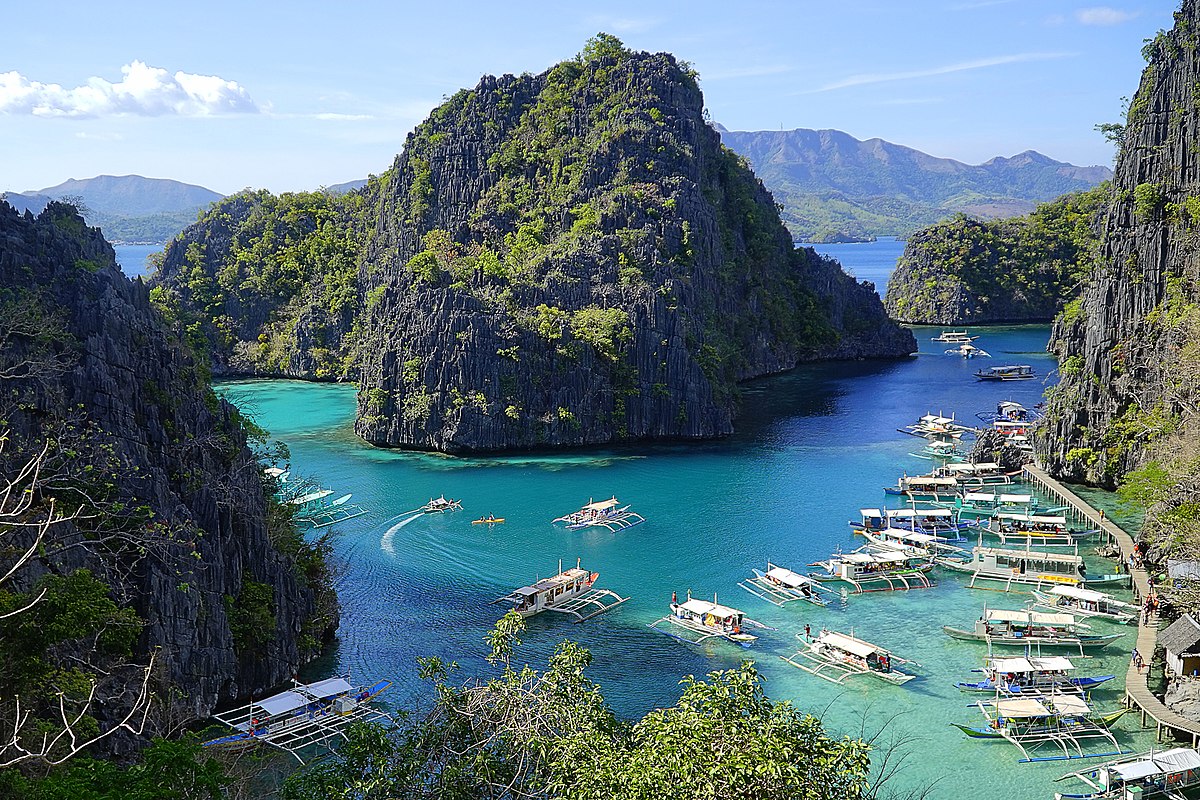
The beautiful island of Palawan.
We planned that within 14 days, we would be able to conclude the operation and break down the EAB, exfilling through littoral combat ships boarding at Puerto Princesa Port. Of course, even such a short operation necessitates a complex chain of logistics, the sorting out of which turned out to be a major aspect of the project. As it turns out, when you introduce a novel warfighting capability, it comes along with a myriad of similarly novel logistical questions. For instance: who’s gonna be building it?

Sony Semiconductor Solutions Group in Oita, Japan — great place to build a killer drone, I hear.
Our answer was the storied Ford Motor Company, at least for the actual automotive parts. The computers were to be manufactured in Sony’s facilities in Oita, Japan. The components would be brought by transcontinental rail from Ford’s manufacturing facilities to the West coast, then shipped to Japan on civilian crewed ships under the purview of Military Sealift Command. An attached motor transport platoon would handle maintenance, while CASEVAC would be by helicopter, with the USNS Comfort waiting nearby.
Looking back at this write up, I am somewhat stunned at the sheer amount of painstaking detail that went into the project. Most of my groupmates were either NROTC or active duty marines (one was a Staff Sergeant), so I guess it checks out. Going into taking Evolution of Warfare, much of the above text would have looked like absolute gibberish to me, but I just played a quite active role in hashing it out.
I love concentrating in security policy.